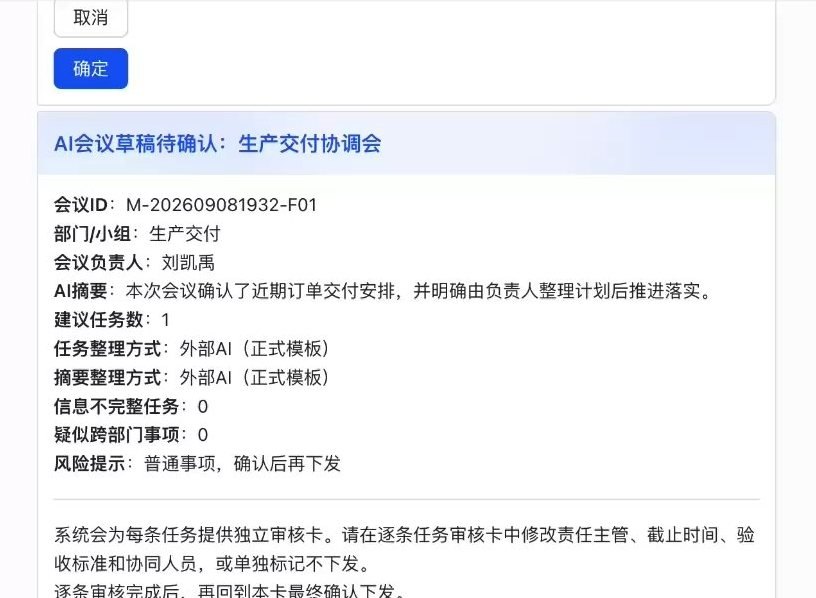
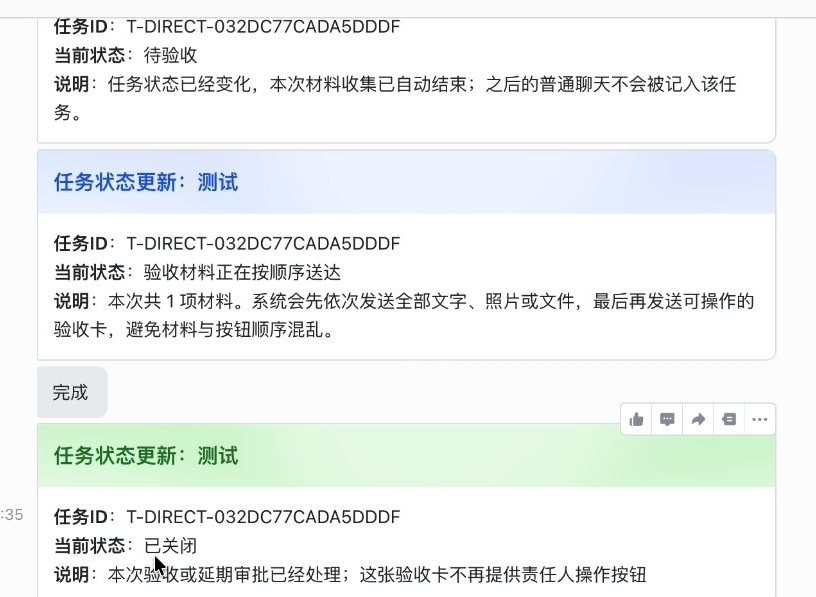
Reconnecting the broken stretch after a meeting — who does it, by when, who signs off. I mapped requirements and business rules, and drove testing, the trial deployment and supervisor training. Drafts dispatch only after the owner confirms; unclear matches go to a named person.
Deployed trialMaking a meeting reach task acceptance
From Lark minutes to task dispatch, evidence collection and human acceptance.
I led requirements and workflow design, testing, trial deployment and supervisor training. Technical implementation was completed through AI-assisted work and collaboration.
12task drafts from one real end-to-end run
1collaboration item from the same run
23tasks dispatched during training
22page supervisor guide
A 52-second demo of draft review, dispatch, evidence submission and human acceptance. One task is shown; unrelated chats are cropped out.
AI draft awaiting reviewHuman acceptance
A meeting ending does not mean work has begun.
Minutes preserve discussion, but execution still needs an owner, deadline, required evidence and an acceptor. I structured that missing responsibility chain into an operable workflow.
How I divided work between AI and people
A draft becomes a task after review
I put ownership, deadlines and acceptance criteria into the review step so the meeting owner can check each task before dispatch.
Uncertain matching needs a named person
Minutes can match more than one meeting. I requested a selection card for a designated owner rather than an automatic guess.
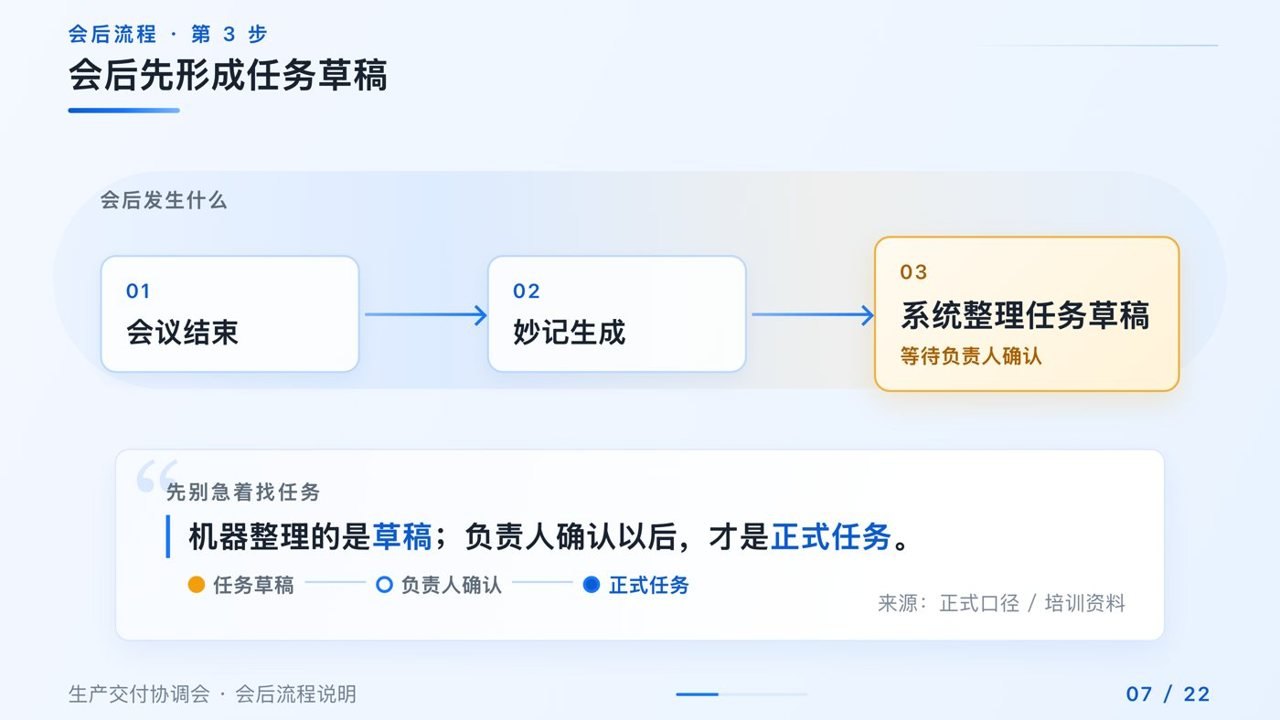
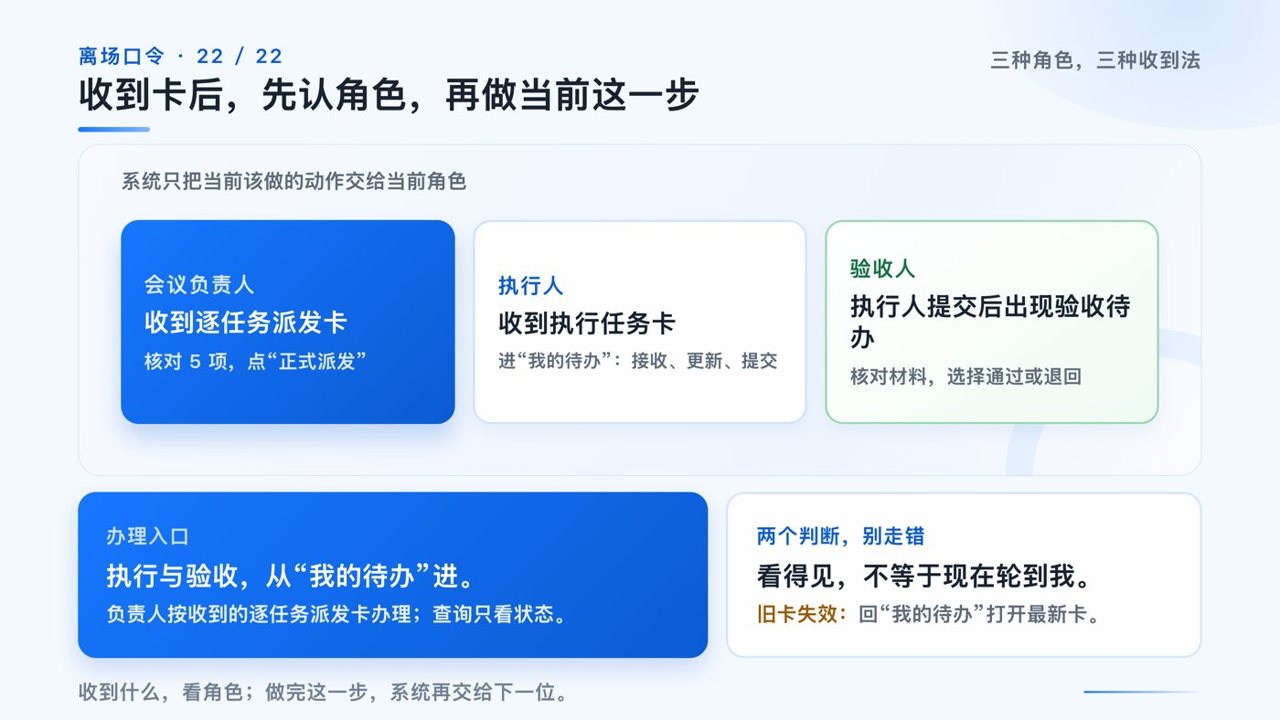
Training material
I created a 22-page supervisor guide, ran the demo and Q&A, gathered feedback and revised the instructions and review flow.
The rule first: AI drafts, it does not dispatchThen the steps: find your next action by role
Slides are in Chinese, as used in training.
Evidence and limits
The video demonstrates one task; the 12 drafts come from a separate real meeting run. A later operating record showed a delivered selection card awaiting human input; it does not establish that the selection was completed.
LANOVA project practice, Jun–Sep 2026: turned visual references into review standards for images and copy, pushed for a dedicated AI reviewer role, compared candidates, added whole-set review, and turned recurring issues into reusable rules.
Aesthetic review & feedbackAI said it could ship. I kept revising.
Developing AI-assisted aesthetic review, output checks and iterative guidance for Xiaohongshu content.
My part: references, comparisons, reviewer feedback and rule updates. AI assisted with the rubric, generation, rewriting and layout.
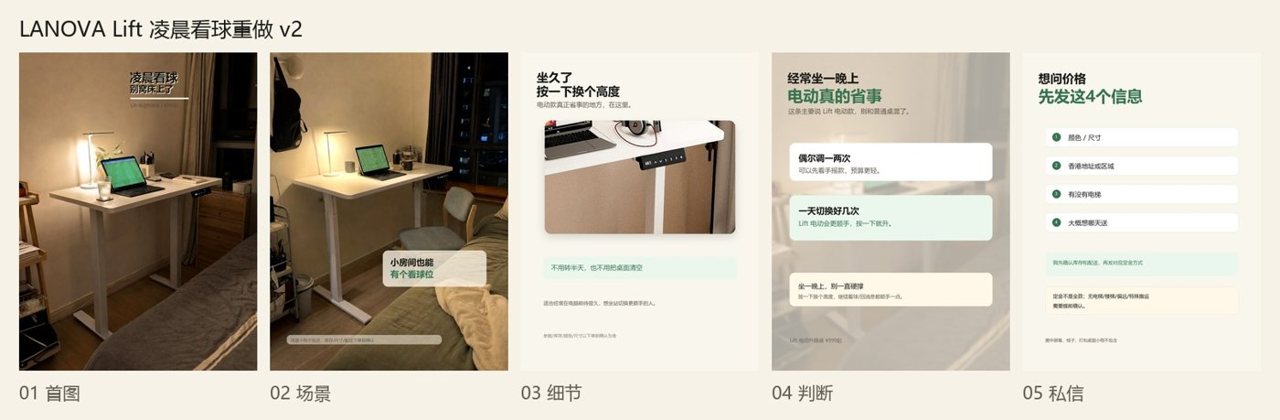
One real review: the late-night football post for Lift
Internal review scores, not audience ratings or performance metrics.
Current v2 overview, not the image at the 84-point approval. Scenes include AI-generated content; prices are not current offers.
Translate style requirements into concrete review criteria.
I established a dedicated review role, selected references and used AI to organize the requirements into ten dimensions totaling 100 points. The review covered cover messaging, atmosphere, text density, product recognition and business constraints.
Judge by comparison
The initial Simple desk review lacked consistent criteria for atmosphere and visual distractions. I introduced side-by-side evaluation of background elements, distracting props and visual focus, and clarified the production direction.
Candidate A / AI-generated sceneRevised along direction B / AI-generated scene
Evidence and limits
These are separate iterations on different works, not one combined success story. Scores of 54, 78 and 84 come from review records; the exact image at the 84-point approval is missing. The initial rubric required 85 for approval, despite the actual approval at 84 — found in the retrospective, not resolved at the time. There is no evidence of parameter training, audience A/B testing or growth impact, and candidate or approved files do not necessarily establish publication. Human acceptance remains necessary rather than relying on a score alone.
I led the whole process from topic to release: topics from real conversations, research and framing, recording and re-recording on camera; AI helped with editing, subtitles and cover, and I checked the cut and the release copy. Episode 1 is done in two parts.
Ongoing content practiceMaking the key point clearer
Two highlights from Episode 1 of “Listening to 100 People’s Worries”, plus illustrated psychology posts on Xiaohongshu.
My work: informal face-to-face listening and reflection, research, recording and re-recording, delivery and final checks. This is non-clinical listening and sharing, not clinical treatment.
Part 1 · 46s: separating facts from worries
Starting from a worry that a friend will not accept one’s flaws, the clip explains mind-reading assumptions and separates what the other person actually said from what one fears; the feeling is real, but the inference still needs evidence.
My own Chinese narration with Chinese subtitles
Part 2 · 63s: one result is not all the effort
On job-search results and self-evaluation: using a search that fell short, the clip explains all-or-nothing self-evaluation and separates whether the goal was met, what was built along the way, and what to adjust next.
My own Chinese narration with Chinese subtitles
Illustrated post: the focusing illusion
Using a sports car and life satisfaction as the example: when we picture one thing, we tend to overestimate how much it will change overall satisfaction.
Limits
Psychology knowledge sharing and non-clinical listening; no diagnosis or treatment advice.
Turned a real inquiry-to-quote process into a working local demo. I owned process mapping, test scenarios, safety rules and output checks: similar models are only flagged, prices are confirmed by the salesperson, nothing is sent to clients automatically.
Local trial demoOrganize the inquiry first; people confirm the quote
From inquiry entry to an illustrated XLSX quote, keeping the commercial judgment human.
My work: business flow, test scenarios, safety rules and output review. Technical implementation was completed through AI-assisted work and collaboration.
155page product source
240+regression checks across the project
Humanconfirms prices and the final file
Noautomatic customer send
Local trial: entering an inquiry, choosing and confirming prices, generating the file.
Less repetitive sorting, without deciding for the salesperson
Inquiry wording, models, configurations and price sources vary. The demo first structures the information for checking, then the salesperson chooses prices, checks customer details and generates the file.
How I judged whether it was usable
Review the file people actually receive
I opened generated quotes beside the original template and raised image size, readability and print proportions as revision requirements.
Similar models are only suggested
Prices, customer details and the final file must be confirmed by a person; nothing is sent to customers automatically.
Evidence and limits
A local trial, not in production. No automatic customer send. Not connected to real customer, order or finance systems.
Understand the work, drive adoption, explain clearly.
I care whether people understand a workflow, whether it can be adopted, and whether a conclusion has evidence behind it.
My practice covers AI-assisted workflows, testing and training, alongside psychology content, with a focus on project operations, customer enablement and content / community work. Technical implementation is completed through AI-assisted work and collaboration.
School
Lingnan University · Psychology
Study
Expected completion May 2027; degree award July 2027
Focus
Project operations · Customer enablement · Content / community
Based in
Hong Kong / Shenzhen
Relevant experience
2024 · Xiamen Media Group · New media operations intern, nearly 20 published pieces.